By Diwakar Sinha
Great businesses don’t always command great valuations. Here’s what to do about it.
Founders often assume valuation is a simple equation: grow revenue, grow EBITDA, get a higher multiple. But that’s not how buyers think. Buyers don’t pay for the business you feel you’ve built, they pay for the business they can underwrite with confidence.
At Polaris Healthcare Partners, we see this disconnect every day. A founder believes they’ve built a strong, stable company. A buyer sees risk, inconsistency, or fragility hiding beneath the surface. And that gap, between perception and underwriting is where valuation is won or lost.
Buyers aren’t paying for your past. They’re paying for the predictability of your future.
Here’s what they actually value.
Predictability Beats Growth Every Time
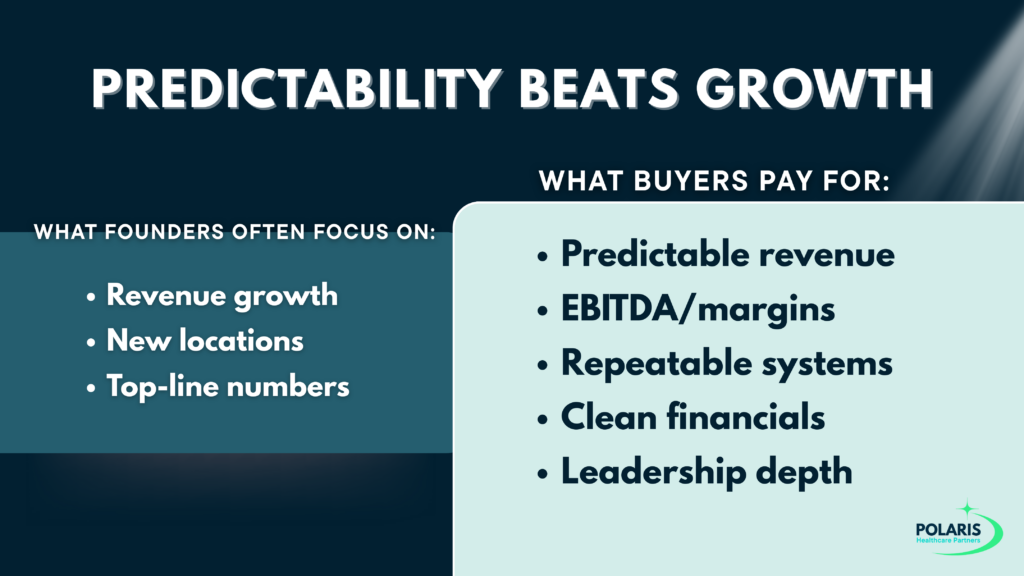
Founders love talking about growth. Buyers love talking about predictability.
A company growing 20% with inconsistent margins, volatile KPIs, and founder‑dependent operations is less valuable than a company growing 8% with stable, repeatable, transferable systems.
Predictability shows up in:
- Consistent revenue patterns
- Stable margins
- Repeatable processes
- Reliable customer behavior
- Clean financials
- Strong leadership depth
Buyers will always pay more for a business they can model with confidence, even if the growth rate is modest.
Quality of Earnings Matters More Than the Number Itself
Founders often focus on EBITDA as a headline metric. Buyers focus on the quality of that EBITDA.
They want to know:
- Is revenue recurring or one‑time?
- Are margins sustainable or inflated by short‑term decisions?
- Are expenses normalized or padded with personal items?
- Are there hidden risks in the cost structure?
- Are there adjustments that won’t hold up under scrutiny?
A $5M EBITDA business with clean, defensible earnings is worth more than a $6M EBITDA business with questionable adjustments.
Quality > quantity.
Scalability Is the Ultimate Value Multiplier
Buyers don’t just buy what you’ve built, they buy what they can build on top of it.
Scalability shows up in:
- Documented processes
- A leadership team that can run the business without the founder
- Systems that support growth
- A clear path to expansion
- Operational consistency across locations or units
If a buyer believes they can double the business without doubling the headaches, your valuation goes up fast.
Leadership Depth Is a Hidden but Critical Driver
Founders often underestimate how much buyers care about the team behind them.
Buyers want to see:
- A leadership bench that can operate independently
- Clear roles and accountability
- Succession plans
- A culture that isn’t founder‑centric
- Leaders who understand the numbers, not just the operations
A strong team reduces risk. Reduced risk increases valuation. It’s that simple.
Market Positioning Shapes Buyer Appetite
Two companies with identical financials can command wildly different valuations depending on how they’re positioned in the market.
Buyers look for:
- Defensible differentiation
- Strong brand reputation
- Clear competitive advantages
- Attractive customer segments
- A compelling growth story
Positioning isn’t marketing fluff, it’s strategic framing. And it directly influences how buyers perceive your future potential.
Transferability Is the Silent Deal‑Maker
Buyers want to know the business will run smoothly on Day 1 after the transaction.
Transferability includes:
- Documented SOPs
- Clear financial reporting
- Repeatable sales processes
- Standardized operations
- Minimal founder dependency
If too much of the business lives in your head, or in the heads of a few key people buyers see fragility. Fragility gets priced in.
Risk Reduction Drives Multiples Up
Buyers don’t pay for upside until they’ve priced in the downside.
The biggest risk factors they look for:
- Payor concentration
- Regulatory exposure
- Operational inconsistencies
- Margin volatility
- Weak financial controls
- Lack of data discipline
The fewer risks they see, the higher the multiple they’re willing to pay.
Narrative Alignment Is the X‑Factor
This is the part founders rarely think about.
Buyers aren’t just evaluating your numbers; they’re evaluating whether your story matches your numbers.
When your narrative, your KPIs, your financials, and your team all reinforce each other, buyers feel confidence. When they don’t, buyers feel doubt.
And doubt is expensive.
Why This Matters Long Before You Sell
You can’t fix these drivers in 30 days. You can’t fix them once you’re already in diligence. And you definitely can’t fix them after buyers have formed their first impression.
The founders who achieve the strongest outcomes are the ones who start preparing 6–18 months before they ever go to market. They understand that valuation isn’t created at the finish line, it’s created long before the race begins.
Buyers pay for predictability, scalability, transferability, and clarity. Founders who invest in those areas early don’t just get better valuations; they get better options.
Stay Connected
- Want to learn how Polaris can help? Reach out anytime.
- Follow our podcast for the latest insights! New episodes every Thursday.