
By Diwakar Sinha
Founders rarely lose valuation because their business is weak. They lose valuation because they waited too long to fix what buyers care about.
At Polaris Healthcare Partners, we see this pattern constantly. A founder decides they’re “ready to sell,” and only then begins preparing for the process. But by that point, the narrative is already formed, the numbers are already baked, and the risks buyers will price into the deal are already visible.
The most expensive mistake founders make isn’t operational. It’s timing.
And the cost of waiting doesn’t show up suddenly, it compounds quietly over years.
Value Erodes Quietly, Not Suddenly
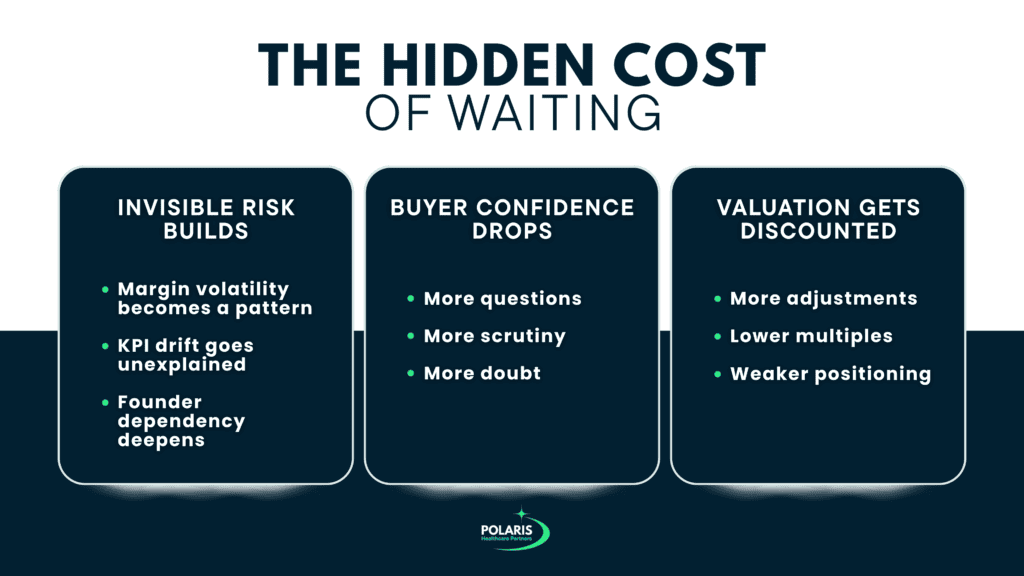
Most founders imagine valuation erosion as a dramatic event: a bad quarter, a lost provider, a reimbursement change. But that’s not how buyers think.
Buyers price risk. And risk accumulates slowly.
It shows up in:
- Margin volatility that becomes a pattern
- KPIs that drift without explanation
- Processes that never get documented
- Provider or founder dependency that deepens over time
- Leadership bandwidth that shrinks as the business grows
- Operational inconsistencies across locations
- Data discipline that never fully matures
None of these feel urgent in the moment. But buyers see them instantly, and they price them aggressively.
The “Preparation Premium” vs. the “Diligence Discount”
Founders who prepare 12 – 18 months early consistently achieve stronger outcomes. Not because their businesses are inherently better, but because they’ve eliminated the surprises that cause buyers to hesitate.
Early preparation creates a Preparation Premium:
- Clean, defensible financials
- A leadership team aligned and confident
- A narrative that matches the numbers
- Documented processes that reduce perceived risk
- Predictable KPIs buyers can model
- A business that feels transferable on Day 1
When founders wait, they experience the opposite, the Diligence Discount:
- More adjustments
- More scrutiny
- More questions
- More doubt
- More downward pressure on multiples
Buyers don’t discount because they want to. They discount because they have to.
Why Healthcare Founders Are Hit Hardest
Healthcare businesses, especially specialties like plastic surgery, behavioral health, orthopedics, urgent care, dermatology, dentistry, and bariatric care, carry unique risk profiles.
Waiting amplifies those risks.
Healthcare buyers are hypersensitive to:
- Payor concentration
- Provider dependency
- Regulatory exposure
- Clinical variability
- Documentation gaps
- Operational inconsistency across sites
- Margin compression tied to staffing or reimbursement
When these issues aren’t addressed early, they don’t just reduce valuation; they may reduce buyer’s appetite.
The Myth of “We’ll Fix It When We’re Ready to Sell”
This is the most common and most damaging assumption founders make.
By the time you decide to sell:
- Your financial patterns are already established
- Your operational habits are already visible
- Your leadership structure is already set
- Your KPIs already tell a story
- Your risks are already baked into the business
You can’t retrofit predictability. You can’t retrofit scalability. You can’t retrofit transferability.
And you definitely can’t retrofit buyer confidence.
The 6-18 Month Advantage
When founders start preparing early, everything changes:
- They understand the buyer’s mindset
- They’ve already surfaced their blind spots
- Their financials are clean and normalized
- Their leadership team is aligned and ready
- Their narrative is tight, consistent, and supported by data
- Their operations feel stable, repeatable, and transferable
They enter the market with clarity instead of fear. They enter diligence with confidence instead of defensiveness. They negotiate from strength instead of uncertainty.
Early preparation doesn’t just improve valuation; it expands your options.
The Real Truth: Time Is a Value Lever
Founders think valuation is about performance. Buyers know valuation is about confidence.
And confidence is built over time, not when you are going to market.
The founders who achieve the strongest outcomes aren’t the ones with the fastest growth or the biggest EBITDA. They’re the ones who understood that preparation isn’t an event. It’s a strategy.
The cost of waiting is real. But so is the premium for getting ahead of it.